In an era where indoor air quality has become a critical determinant of public health, the emergence of the battery operated air purifier represents a significant leap in medical and domestic wellness technology. These portable systems provide a vital safety net for individuals with respiratory sensitivities, ensuring that clean, filtered air is available regardless of the proximity to a power outlet, thereby bridging the gap between clinical-grade filtration and everyday mobility.
The global demand for cordless air purification is driven by the increasing prevalence of airborne pollutants and the necessity for flexible healthcare solutions in both home-care and emergency settings. By integrating high-efficiency particulate air (HEPA) filtration with advanced battery chemistry, the battery operated air purifier allows users to maintain a sterile personal environment in transit, in waiting rooms, or in remote areas where electricity is unstable.
Understanding the technical nuances and application scenarios of these devices is essential for healthcare providers and consumers alike. This guide explores the intersection of portable power and air science, detailing how the battery operated air purifier serves as a cornerstone for modern respiratory health management and environmental control.
Global Context of Battery Operated Air Purifiers
Across the globe, air pollution has reached a critical threshold, with the World Health Organization (WHO) reporting that a vast majority of the urban population breathes air that exceeds safety guidelines. In this context, the battery operated air purifier has evolved from a luxury gadget to a necessary medical tool, particularly in regions where power grids are unreliable or where patients require constant air filtration during transport.
The integration of these devices into the broader medical equipment ecosystem—alongside oxygen concentrators and hyperbaric chambers—highlights a systemic shift toward decentralized healthcare. By removing the tether of the power cord, the battery operated air purifier empowers patients to maintain their health standards while remaining active in their social and professional lives.
Defining the Battery Operated Air Purifier
At its core, a battery operated air purifier is a portable device designed to remove contaminants from the air through a series of filters, powered by an internal rechargeable energy source. Unlike stationary units, these devices are optimized for "micro-environment" purification, focusing on the immediate breathing zone of the user to ensure maximum efficiency with minimal energy consumption.
From an industrial perspective, these devices represent a convergence of filtration science and battery management systems (BMS). They typically employ HEPA (High-Efficiency Particulate Air) or ULPA filters capable of capturing 99.97% of particles as small as 0.3 microns, making them effective against dust, pollen, smoke, and various airborne pathogens.
In humanitarian and medical contexts, the definition extends beyond simple filtration. It is viewed as a "portable protective shield," essential for individuals with severe asthma, COPD, or those recovering from surgical procedures where the risk of airborne infection must be strictly managed regardless of the location.
Core Components and Engineering Factors
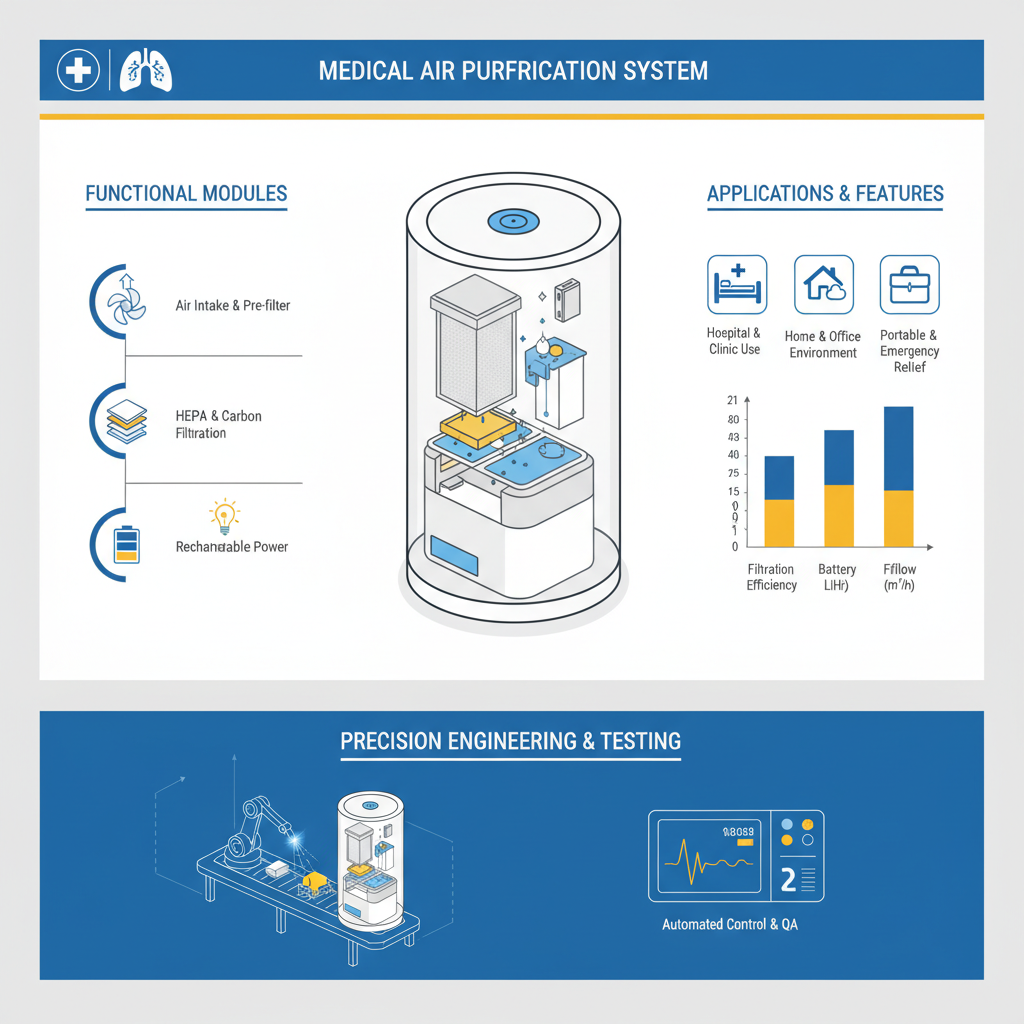
The efficiency of a battery operated air purifier is primarily determined by its CADR (Clean Air Delivery Rate) relative to its energy draw. Engineering these devices requires a delicate balance between fan power, filter density, and battery capacity to ensure the device remains lightweight while providing meaningful air exchange.
Central to the battery operated air purifier is the Lithium-ion or Lithium-polymer battery cell, which must be paired with a sophisticated BMS to prevent overheating and extend the lifecycle of the device. The quality of the filter media—whether it be electrostatic or mechanical—directly impacts how much work the motor must do, which in turn affects the total runtime on a single charge.
Durability and scalability are also key factors. A professional-grade battery operated air purifier often features medical-grade housing materials that are resistant to chemical disinfectants, ensuring that the device can be sterilized in clinical environments without degrading the plastic casing or the internal electronics.
Practical Applications and Use Cases
The versatility of the battery operated air purifier makes it invaluable across diverse sectors. In medical transport, it is used to create a "sterile bubble" around patients moving between wards or in ambulances, reducing the risk of hospital-acquired infections. In the corporate sector, executives and travelers use them in aircraft cabins or hotels to mitigate the effects of recirculated air and allergens.
Furthermore, in post-disaster relief operations where infrastructure is destroyed, these units provide immediate respiratory support to victims in temporary shelters. Their ability to function without a grid connection makes them an essential component of emergency medical kits, complementing other portable devices like small oxygen concentrators.
Performance Comparison of Battery Operated Air Purifier Technologies
Tangible Benefits and Long-Term Value
The most immediate benefit of a battery operated air purifier is the psychological and physical liberation it provides. For users who previously felt trapped within the reach of a power outlet, these devices offer a sense of dignity and autonomy, allowing them to navigate the world with confidence in the air they breathe.
From a long-term value perspective, investing in high-quality portable purification reduces the frequency of respiratory flare-ups and subsequent hospitalizations. This creates a positive economic loop: lower healthcare costs for the individual and reduced strain on the public health system, proving that the battery operated air purifier is not just a product, but a preventive health strategy.
Future Trends in Portable Purification
The next generation of the battery operated air purifier is moving toward "smart" integration. We are seeing the rise of IoT-enabled sensors that detect air quality in real-time and automatically adjust the fan speed to optimize battery life, ensuring that the device only works hard when pollutants are actually present.
Furthermore, the transition to solid-state batteries promises to revolutionize these devices by offering higher energy density and improved safety. This will allow for smaller, lighter units that can operate for days rather than hours, further expanding the utility of the battery operated air purifier in extreme remote environments.
Sustainability is also becoming a focal point. Future designs are incorporating biodegradable filter media and modular battery packs that can be easily replaced or recycled, aligning the pursuit of clean air with the goal of a clean planet.
Challenges and Expert Solutions
One of the primary challenges facing the battery operated air purifier is the inherent trade-off between filter efficiency and battery longevity. High-density filters create more resistance, requiring the motor to draw more current, which drains the battery faster.
To overcome this, experts are developing "hybrid filtration" systems that combine coarse pre-filters with electrostatic precipitation. This approach reduces the physical resistance of the air stream, allowing the battery operated air purifier to maintain high filtration standards while significantly extending its operational window.
Another hurdle is the maintenance of portable units. To address this, industry leaders are implementing smart alerts and subscription-based filter replacement programs, ensuring that users always have a fresh filter, which is critical for maintaining the device's energy efficiency and air-cleaning power.
Technical Analysis of Battery Operated Air Purifier Specifications
| Model Type |
Battery Life (Hours) |
Filtration Grade |
Noise Level (dB) |
| Compact Personal |
12-15h |
HEPA H13 |
32 |
| Medical Transport |
8-10h |
ULPA |
45 |
| Industrial Portable |
20-24h |
HEPA H14 |
55 |
| Eco-Lite Series |
30h+ |
Standard HEPA |
28 |
| Hybrid-Ionic |
18-22h |
Combo Filter |
38 |
| High-Capacity Pro |
6-8h |
ULPA Medical |
50 |
FAQS
Battery life varies significantly by model and fan speed. Most high-quality battery operated air purifiers offer between 8 to 24 hours of continuous use on a full charge. To maximize runtime, users are encouraged to use "Auto Mode," which only increases power when air quality sensors detect a spike in pollutants.
Yes, provided the device uses a HEPA H13 or higher filter. These filters are designed to trap microscopic particles, including the droplets that carry viruses and bacteria. For clinical environments, models equipped with ULPA filters or UV-C light integration offer an even higher level of sterilization.
Most modern units are designed with "pass-through" charging, allowing them to operate while plugged into a power source. However, we recommend checking the manufacturer's guidelines to ensure the battery management system is optimized for this, as constant charging while discharging can sometimes generate excess heat.
Typically, filters should be replaced every 3 to 6 months, depending on the environment. In highly polluted areas or medical settings, replacements may be needed more frequently. Using a saturated filter not only reduces air quality but also forces the battery to work harder, shortening the device's runtime.
Most personal-grade battery operated air purifiers operate between 25 and 40 decibels, which is comparable to a quiet library or a whisper. Higher-capacity medical models may be louder (45-55 dB) due to more powerful motors, but they are typically used in environments where such noise is acceptable.
No. It is important to distinguish between the two. An air purifier removes contaminants from the existing air, whereas an oxygen concentrator increases the concentration of oxygen. They serve different medical purposes, though they are often used together to ensure a patient breathes clean, oxygen-rich air.
Conclusion
The battery operated air purifier stands as a pivotal innovation in the intersection of mobility and respiratory health. By combining advanced HEPA filtration with reliable portable power, these devices dismantle the barriers to clean air, providing essential protection for vulnerable populations and enhancing the quality of life for those in challenging environments. From medical transport to daily urban commuting, the value of these systems lies in their ability to provide consistent, reliable, and autonomous environmental control.
Looking ahead, as battery technology evolves and smart sensors become more integrated, we can expect these devices to become even more efficient and unobtrusive. For healthcare providers and individuals seeking to safeguard their respiratory well-being, investing in a high-quality battery operated air purifier is a proactive step toward a healthier, more flexible future. Visit our website to explore our professional range: www.storeoxygen.com.